

Proyecto Vínculos in Málaga: a Welcoming Space
Report on the First Four Months
January 31 – May 31, 2025
On January 31, 2025, we opened the doors of Vínculos Project in Málaga, a delegation of the Fundación Asha-Kiran created with a clear mission: to establish a Space of Welcome for people in vulnerable situations, regardless of their origin, religion, or gender.
From the outset, we dreamed of a space that would be inclusive, open, and deeply human—capable of responding to diverse needs through a logic of care, connection, and dignity. Though the project is still young, it is already very much alive.
Spanish Language Classes: The Starting Point
The very first activity we launched was Spanish language classes, and they quickly became the bridge that connected us with a network of organizations and individuals who believed in our mission from day one.
Organizations like CEAR (Spanish Commission for Refugee Assistance) and Málaga Acoge began referring students to us as soon as we opened. Soon after, others joined in: CODENAF (Cooperation and Development with North Africa), Puerta Única (a municipal service that assists unhoused and migrant individuals), and CREADE (a Reception, Care, and Referral Center focused on Ukrainian nationals).
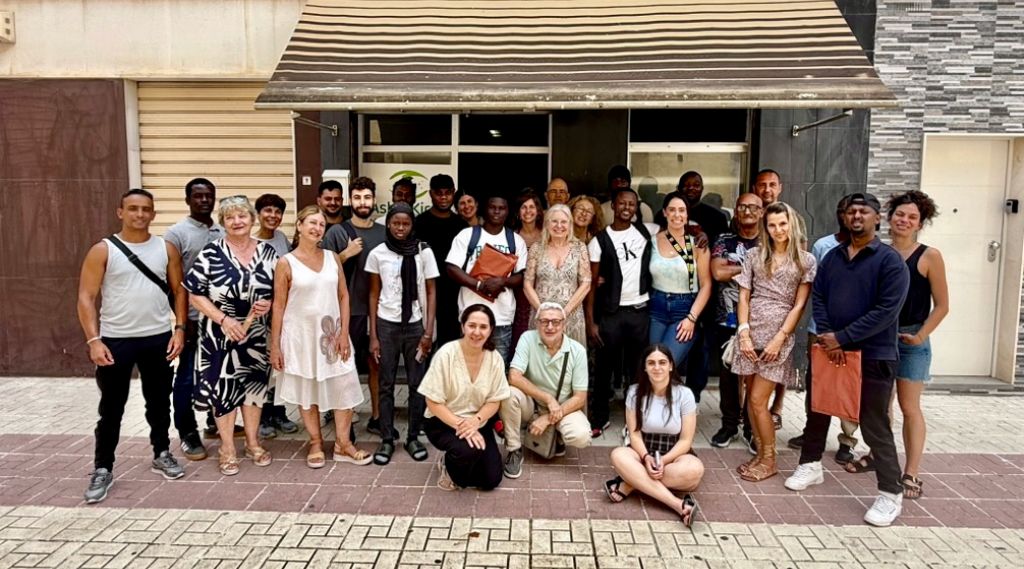
In just four months, nearly 200 people—primarily from African and Ukrainian backgrounds—have passed through our classrooms. With each lesson, each conversation, each word shared, we have built much more than an educational activity: we have woven a growing community.
Volunteering: The Heart of Proyecto Vínculos
Proyecto Vínculos is sustained by a network of volunteers that continues to expand every week. At first, many came from our immediate surroundings, particularly from the Escuela Camino 4. Today, we count more than 35 active volunteers, not including those who support social media and other areas.
Classes are organized in groups of up to 15 students, with at least two volunteers per shift, and coordinated by Vasumati. Currently, we run five weekly shifts, and we aim to keep our doors open as many days as possible—because something unexpected always happens when the door is open.
That’s how we met M., who came on his own, simply wanting to learn Spanish. Or E., who arrived looking for a shower, some clean clothes, and—above all—a warm welcome. Gradually, even neighbors from the local plaza began to stop by, worried about people sleeping on the streets, pointing out those who might need support.
Asha-Kiran is slowly becoming a reference point for the neighborhood.
A Place Built by Everyone
In addition to in-person classes, we’ve developed online Spanish classes, highly appreciated by students and currently led by Nilay and Kirat, two dedicated volunteers who have sustained this line of work with commitment.
Another major step has been the launch of the Volunteer Companions Program (Programa de Referentes), a beautiful initiative where migrants are paired with volunteers who meet with them at least once a week to talk, exchange cultures, practice the language, and most importantly, to offer human connection.
It’s not about solving someone’s life—it’s about being there, listening, guiding when possible, and fostering familiarity. Sometimes, just knowing where the library is, or taking a walk through the city with someone, can help you see that city through new eyes. Places change when we care about the people who live in them.
This program is coordinated by Sundari, director of our projects in Spain, who previously helped build a network of more than 250 volunteer companions in Barcelona. In Málaga, we are just getting started, and already several people have signed up to become companions.
New Activities, New Lives
The project continues to grow thanks to ongoing contributions from volunteers and participants. One of the latest additions is music therapy, coordinated by Ignacio. While it’s still too early to measure its full impact, the very fact of its existence shows that this space is alive and evolving.
We’ve also launched a digital literacy campaign, made possible by a call on social media for donations of phones, tablets, and laptops. Benet, a volunteer, has offered to lead the classes, which are set to begin on June 10. We’ve already received three laptops and a tablet and more continue to arrive.
In parallel, a network of donations has formed around the project—offering clothing, notebooks, school and sports supplies. At the moment, t-shirts and shorts are among the most requested items. We also help circulate information about donation opportunities elsewhere in the city. One volunteer informed us of a clothing drive, and we were able to spread the word among our students and other organizations.
Ceramics, Yoga, Museums - and a Cup of Tea
Among the most uplifting activities are our cultural outings. We’ve already visited two museums and are planning an excursion to Antequera and another to Granada. These are coordinated by Loï, a volunteer who manages schedules, connects with participants, and finds engaging cultural experiences.
We also offer ceramics and yoga workshops, along with other activities that emerge from shared interests and needs.
And then there are the small details that say it all. A sofa to sink into. A box of biscuits. A kettle always ready. Many arrive, help themselves, settle in. They are no longer just students—they are at home.
In one Spanish class, while practicing the verb “I like / I don´t like”, more than one student said:
“What I like most is coming to class.”
That is the environment we dreamed of. And that is the environment we are building—together.

Thanks to the support of Málaga City Council.