

Where are they from? I don’t know—it’s my brother, my sister.
Twenty months of Vínculos Project, seen through the eyes of Dayana, Fundación Asha-Kiran’s representative in Málaga.
A year and a half have gone by since Vínculos Project was launched in Málaga.
When we decided to embark on this adventure—with a donated space as our first step into the unknown—we weren’t aware of the impact it would have on the city, on the beneficiaries, on the volunteers, and, more broadly, on the public at large.
Nor was I aware of the impact it would have on me.
We were very certain that the project would be aimed at the most disadvantaged people with the least support networks: migrants living on the streets or in highly precarious housing conditions; people who had endured extremely long migration journeys, with experiences of loss, war, slavery, or exploitation; and asylum seekers and refugees.
We set out to offer all of them a welcoming space where they could go. And to do so, we wanted to mobilize the community and the neighborhood, offering Spanish and literacy classes taught by volunteers.
And Málaga answered.
From the very beginning, we had enough volunteers to hold four daily classes. They got everything going and were committed to maintaining a space of unconditional welcome and warmth.
Over the past 20 months, more than 900 students have passed through our small 30m² space.
We’ve taught Spanish and listened to stories of long journeys. We’ve provided one-on-one support, arranged housing, helped with paperwork, and offered emotional support. We’ve played and learned to communicate with our hands, our eyes, and our souls.
We’ve gone to museums, to the Fair, participated in a marathon, and visited floating libraries. People with different childhoods, backgrounds, faiths, and languages have come together in a miracle of possibilities and have become friends. We’ve laughed and had a wonderful time. At times, we’ve forgotten who we think we are, the color of our skin, our religion, and so many things that seemingly set us apart.
We’ve come together through language and curiosity.
We’ve given each other advice, exchanged clothes, suitcases, and shoes. We’ve put ourselves in each other’s place and come to understand many things that were previously unclear, clouded by political comments and opinions that are often not even our own—but ones we’ve borrowed.
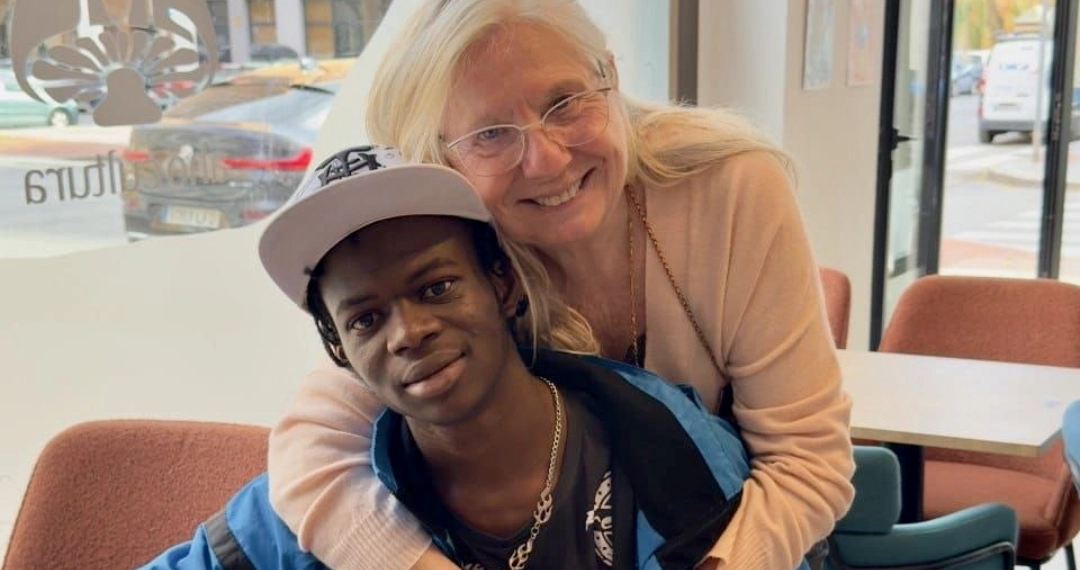
We’ve embraced each other. And when we meet again, we look at each other as if we were looking at a sibling. We recognize each other.
Through the Project, I’ve had the incomparable experience of standing alongside someone you deeply care for because you’ve seen them in their most vulnerable condition, and a sincere desire arises for their situation to improve. We’ve come to understand that when their situation improves, ours does as well. Something shifts; everything falls into place. For a moment, the world seems fairer, and the word “brother” takes on real meaning.
Sometimes people ask me, “Where is this person from? What race are they?” I find it hard to answer. I no longer know if they’re white or black. Skin color and background are no longer what matters. Sometimes I’m surprised because I haven’t even noticed it.
We see each other through the eyes of the soul.
A few days ago, I was at the Foundation talking with a student who is now also a volunteer. There are students who, having received so much love, want to give it back in return and make themselves available to other migrants or refugees who, like them, found in our center a safe place where they were acknowledged and treated with respect.
More and more of them want to give, because they know that giving makes them feel good, too, and that by offering their help, they help make their peers a little happier.
Because those who give are truly rich.
I was with the student volunteer and asked him about a classmate I hadn’t seen in months. I thought he might be working somewhere along the coast. I remembered him fondly: young, cheerful, and not very focused in class. When I looked at him, I thought about all the possibilities that lay ahead of him and, at the same time, about the arduous path those young eyes had already been through.
A few days later, to my surprise, he showed up in class again.
He walked in wearing his robe, he looked impressive. He had grown taller during those months. When we saw each other, we hugged with an intensity and power that surprised me. Meeting again was truly joyful.
He showed me photographs of his family, who had been displaced from Somalia to Kenya: his mother, his wife, his son, and his sister. He told me he had gone to visit them. Now he was back in Málaga, and this time he was genuinely interested in learning Spanish “for sure”.
While he was away, he had missed our country. He loved our country. He was grateful for what he had been given here. He loved our language and wanted to learn some more.
That’s what we volunteers at Vínculos Project strive to do every time we teach a class, organize an outing, mentor someone, or are simply there for them: to make them part of the world we live in, to help them feel that they belong, to show them that no one is excluded here.
Some of our students are from Russia, Ukraine, Somalia, Morocco, Algeria, Guinea, Cameroon, Mali, and Nigeria… and lately, we’ve also been working with people from Germany, France, and Nepal.
The wonder of diversity lies in realizing that, deep down, we all need very similar things: stability, a place to sleep, the means to work, and the ability to support ourselves. And, above all, we need a community to belong to, to feel proud and satisfied with ourselves, and to have the opportunity to grow.
And that’s where volunteers and beneficiaries come together—and sometimes even blur into one another.
Is what most of our students want really so different from what we volunteers want?
I’d say not.
When one of our students reaches a certain degree of stability, they begin to be able to give. And then some decide to become volunteers as well—to help others, but also to help themselves, to find balance, and to feel at peace.
The more welcoming and connecting spaces we can create—spaces where giving takes on greater meaning—the more we will grow as people. And perhaps our children will one day be able to live in a world where there is less fear of the unknown.
Volunteering with Fundación Asha-Kiran has opened my heart. It has taught me another way of looking at the world: it's a gentler, more understanding, and broader perspective.
It moves me to see so many young people hunched over their textbooks, making a real effort to pronounce the sounds of our language: A, B, C, D, E…
They’re not just learning a language. They’re discovering a way of life, culture, history. And their eyes light up, too.
Even if they have to go to sleep on the beach afterward, sometimes they do so repeating phrases in Spanish and truly dreaming that they have a future. That there’s a possibility. That maybe the world isn’t as hostile as it seemed when they had nowhere to turn to.
Now they know there’s a place where they’re always welcome. Where they’re listened to and respected. Where they’re valued for who they are.
Where is he from?
I don’t know. It’s my brother. It’s my sister.
— Dayana, Asha-Kiran representative in Málaga
Help make Vínculos a place people can continue to come to
Behind these encounters there is a small space to keep open, classes to hold, companionship, activities, and, above all, a community of people who have decided not to remain indifferent.
You can be part by volunteering with Vínculos Project and sharing some of your time, or by becoming a member of Asha-Kiran and helping us to continue our endeavor.
We may not be able to immediately transform every circumstance that leads to a person leaving their home. But we can decide how we welcome them when our paths cross.

The Vínculos Project of Fundación Asha-Kiran is funded by Málaga City Council, through the Department of Citizen Participation, Migration, External Action, Development Cooperation, Transparency and Good Governance.