


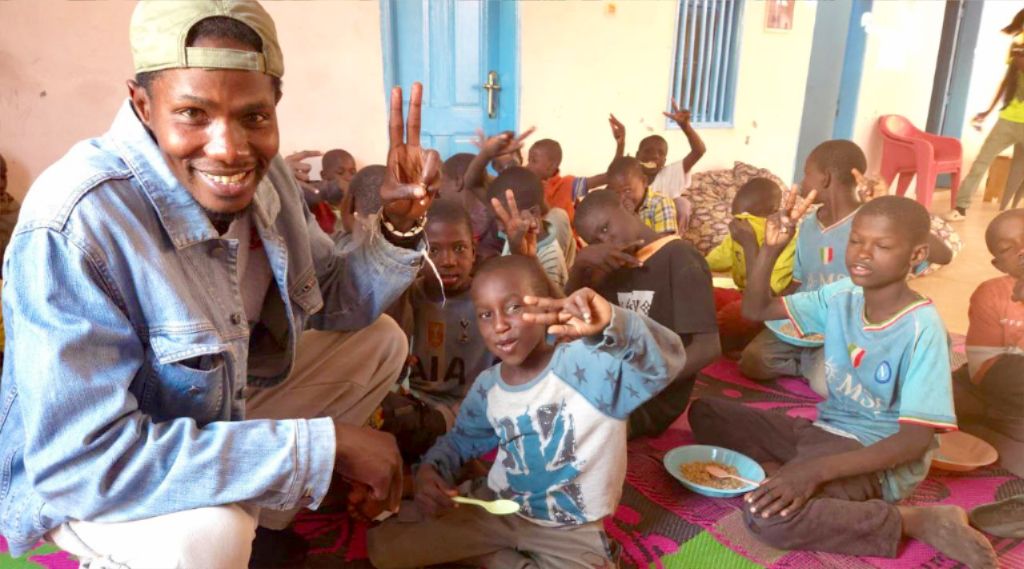
Talibé Children in Senegal: Between Religious Tradition and Child Vulnerability
In Senegal, the term talibé comes from the Arabic word talib, which means “student” or “seeker of knowledge.” Talibés are children entrusted by their families to a Qur’anic teacher—known as a serin daara or marabout—to receive religious education in traditional Qur’anic schools called daaras.
Historically, these schools functioned under a community-based model. Children received religious instruction while the community voluntarily contributed to their sustenance. In that context, begging could sometimes be part of a cultural practice, but it was not a systematic obligation nor a structure of exploitation.
However, processes of rapid urbanization, economic precariousness, and social transformations have profoundly altered this balance. In many informal daaras today, families send their children—sometimes as young as four or five years old—to live and study there under the supervision of a marabout. In many cases, parents live hundreds or even thousands of kilometres away, leaving the children without a close family reference.
In this context, many talibés are required to deliver a fixed amount of money or food to their teacher every day. Begging therefore ceases to be an occasional practice and becomes a daily requirement that, in numerous cases, leads to child exploitation.
Living conditions in some of these daaras are extremely precarious. Poor sanitation, malnutrition, physical punishment, and lack of access to formal education or basic health services form part of the daily reality for many children. Many sleep on the ground, in overcrowded spaces, without mosquito nets, and without regular access to showers or basic hygiene products.
But perhaps the deepest deprivation is another: the absence of a protected childhood—a safe place where children can play, learn, imagine, and grow.
As a result, many children live in conditions of extreme precariousness:
- insufficient food
- lack of sanitation infrastructure
- unsanitary spaces poorly adapted to climatic conditions
- overcrowding in small areas
- prolonged exposure to life on the streets
Although many of these children memorize the Qur’an, they often do not acquire real competence in the Arabic language nor receive a basic formal education. Many remain illiterate, without reading and writing skills, which severely limits their future opportunities.
Faced with a lack of prospects, some young people later become more exposed to high-risk migration routes as a way of escaping marginalization.
Today, the phenomenon of the talibés generates deep debate in Senegal. For some sectors it represents a religious tradition linked to the Sufi Islam of West Africa; for others, imposed begging constitutes a form of child exploitation. The Senegalese state has adopted laws to regulate or prohibit child begging, but their implementation remains complex due to the interrelation of religious, social, and economic factors.
It is important to remember that behind the term “talibé” there is not an abstract category, but a concrete child—with a personal story, family ties, aspirations, and dreams.
The Commitment of Asha-Kiran
At Fundación Asha-Kiran, we have begun working in Senegal with the aim of offering these children something different: a safe space where they can learn, receive basic healthcare, be nourished, and recover something essential that should never be lost—their childhood.
Our purpose is not to confront religious traditions or local communities, but to collaborate with them in order to improve children’s living conditions, provide access to basic education, health, and protection, and open new opportunities for their future.
Because every child deserves more than simply to survive.
They deserve to learn, grow, and dream with dignity.